
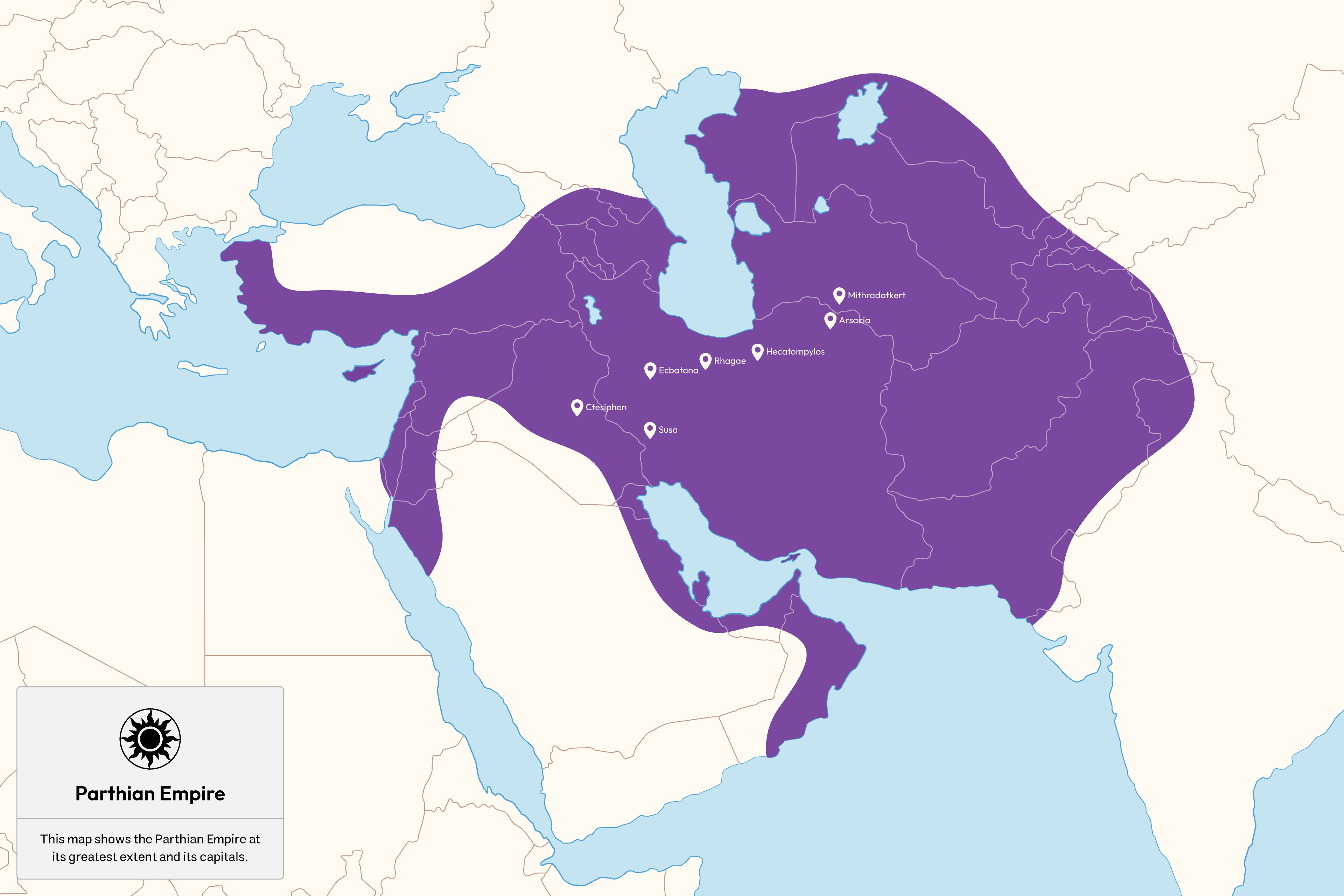
The Parthian Empire represents one of the most important periods in Iranian history. Emerging after the Hellenistic era, it played a fundamental role in the revival of Iranian culture and identity. With a reign lasting nearly five centuries, the Parthians established the longest-lasting dynasty in the history of Iran and succeeded in securing Iran’s political and cultural position in the Middle East and beyond. Nevertheless, the absence of extensive internal written records, the bias of Roman historians, and the blending of historical accounts with legend have made it difficult to reconstruct the precise geographical extent of the empire. This article examines the geographical extent and borders of this empire based on historical documentation and archaeological findings.
Sources for Defining Borders
Reconstructing Parthian geography is a complex task. Available sources can be categorized into several groups:
- Archaeological Evidence: Minted coins, inscriptions, and statues serve as our most reliable documents.
- Roman Historians: While the bulk of written history comes from Rome, it must be approached with caution. Due to long-standing hostility, Roman writers often downplayed Iranian victories and focused almost exclusively on the western borders (the Euphrates), remaining largely ignorant of developments in Eastern Iran.
- Chinese Records: Reports from the ambassadors of the Han Dynasty, though limited to specific periods, provide valuable information regarding the eastern reaches of the empire.
- Traditional Iranian and Armenian Texts: In the Shahnameh and Armenian chronicles, Parthian history is often blended with myth. Ferdowsi himself acknowledged the scarcity of sources on the subject, stating, “Of them I have heard nothing but their name; nor have I seen them in the chronicles of kings.” Nevertheless, much of the national epic and the stories in the Shahnameh reflect the bravery and chivalric ideals of Parthian heroes.
True Heirs to the Achaemenids
Following the fall of the Achaemenid Empire, Alexander and his successors (the Seleucids) attempted to present themselves as the legitimate heirs to the Persian world order. However, it was the Parthians who, with historical consciousness, reclaimed the title of rightful successors to Cyrus and Darius the Great. The Parthian kings did not merely seek to reclaim lost territory; in their diplomatic correspondence with Rome—such as Artabanus’ letter to Tiberius—they explicitly claimed all lands once held by the Achaemenids. By expelling foreign powers from the Iranian plateau, they effectively restored national sovereignty.
Stages of Expansion
Throughout Parthian history, several kings played decisive roles in the expansion and consolidation of the empire’s borders:
- Arsaces: Founder of the Parthian Empire, who relied on the Parni and Dahae tribes and established control over Parthia and Gorgan (Varkāna), forming the initial core of Parthian territory.
- Mithridates I: Initiated major conquests that transformed the Parthians into a regional power; expanded the empire’s frontiers eastward to the Jhelum River and westward into Mesopotamia, including the capture of Seleucia, which effectively ended Seleucid domination over Iran.
- Mithridates II: Elevated the Parthian Empire to the status of a global superpower; defeated eastern nomadic peoples such as the Scythians and Tocharians, stabilized the eastern frontiers as far as the Himalayan foothills, and recorded Parthian territorial reach in Chinese historical accounts (c. 129 BCE), which even describe the lands of the Massagetae as lying within his domain. In the west, Parthian influence expanded through the conquest of Armenia and neighboring kingdoms, as well as the pursuit of invading Arab groups deep into the deserts of the Arabian Peninsula.
- Orodes II: Represented the height of Parthian military power in the west; the decisive defeat of the Romans at the Battle of Carrhae and the crossing of the Euphrates led to Parthian control over Syria, Judea, and parts of Anatolia, vividly demonstrating the offensive capabilities of the Parthian army.
Geographical Scope
The stable territory of the Parthian Empire generally stretched from the Euphrates River in the west to the Indus River in the east, and from the Oxus River (Amu Darya) in the north to the southern shores of the Persian Gulf. Historical evidence indicates that the Parthians exercised full control over the regions east of the Caspian Sea; these areas frequently served as a secure refuge for Parthian kings during times of political crisis.
Etemad os-Saltaneh, a historian of the Qajar era, proposes an intriguing hypothesis based on Armenian sources. He claims that the Caspian Sea was considered an inland lake within Parthian territory. According to this account, the Parthian dynasty consisted of five governing branches, all of which followed the main branch in Iran, with one of these branches stationed north of the Caspian Sea. While the close ties between the Parthians and the northern Scythians have laid the groundwork for such hypotheses (for instance, Vonones I’s attempt to seek refuge with the Scythians of the North Caucasus), it must be noted that due to a lack of definitive documentation, these claims remain historical conjectures.
Unlike the western borders along the Euphrates, which remained relatively static, the Parthians maintained an active and dynamic policy on the eastern front. Several pieces of evidence attest to this:
- The extensive conquests of Mithridates I and II deep into Central Asia
- Phraates IV’s dispatch of Roman prisoners to a Xiongnu prince (near the borders of China)
- The conquest of Khwarazm by Artabanus IV
- The support provided by local rulers of Bactria to Gotarzes II in his battle against Vardanes
Furthermore, the discovery of a bust of Vardanes I in the Khalchayan region (modern-day Uzbekistan) and a statue attributed to Mithridates the Great in Kuwait serve as undeniable evidence of the Parthian Empire’s powerful presence and influence over the vital crossroads of the ancient world.
Conclusion
The Parthian Empire was more than a military force; it was a sophisticated structure that succeeded in safeguarding Iran’s territorial integrity and cultural identity during one of history’s most critical periods. Although many details regarding the conquests and precise borders of this empire remain shrouded in mystery, archaeological evidence and modern analyses depict a global superpower that spanned from Central Asia to Mesopotamia and its western reaches. By reviving the Achaemenid legacy and resisting Roman expansionism, the Parthians provided the foundation upon which Iranian culture could thrive for centuries to come—a legacy whose vastness is evident not only on geographical maps but in the continuity of Iranian civilization to this day.