
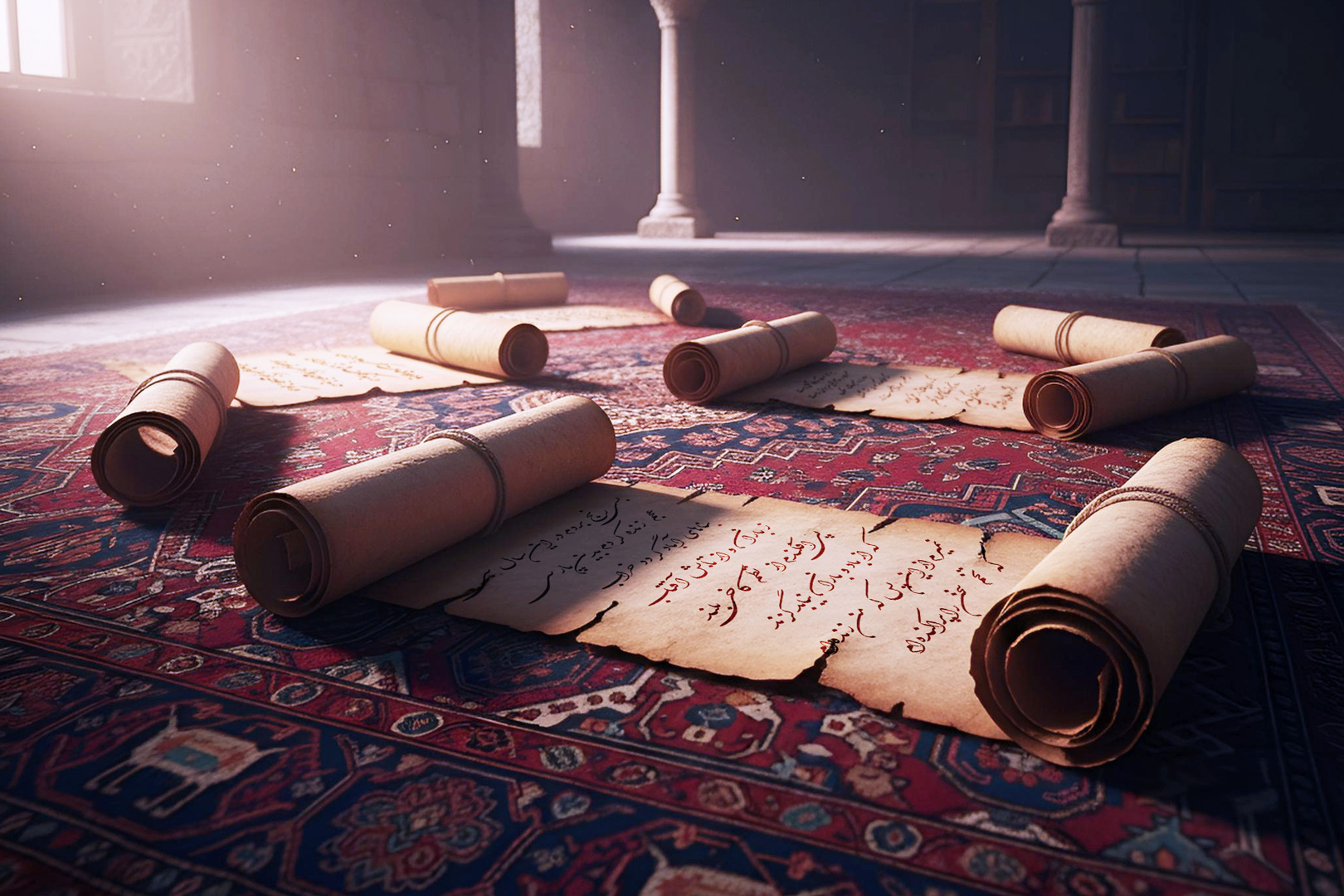
Iranian literature is one of the oldest and most influential literary traditions in the world, with its roots reaching back to the Avestan texts and the culture of ancient Iran. This valuable heritage, expressed mainly in the Persian language and through various forms of poetry and prose, has reflected the beliefs, ideas, and emotions of the Iranian people over thousands of years. The scope of Iranian literature is broad and diverse, encompassing fields such as epic and mythology, mysticism and ethics, wisdom and moral instructions, as well as romantic and philosophical themes. Prominent figures of this tradition include Rudaki, Ferdowsi, Khayyam, Rumi, Saadi, and Hafez, each of whom, through eloquent language and profound thoughts, played an important role in expanding this heritage and establishing Iranian literature as a significant pillar of world literature.
Ancient Iranian Literature
The origins of ancient Iranian literature can be traced to the Avestan hymns. These profound texts, composed in Avestan (one of the oldest Iranian languages) not only contain Zoroastrian beliefs but also form the earliest surviving written works of Iranian civilization. The Gathas, attributed to Zoroaster himself, represent the earliest examples of Iranian poetry in terms of content, style, and metrical form.
Achaemenid Period
Iranian literature during the Achaemenid period, although surviving primarily in the form of inscriptions and governmental documents, provides a clear picture of the worldview, politics, and culture of the Iranians at that time. The official languages of this period, Old Persian and Akkadian (Neo-Babylonian), appear in the inscriptions of Cyrus the Great—such as the Cyrus Cylinder—with a moral and political tone that emphasizes justice, respect for diverse peoples, and the preservation of social order. These texts are among the earliest examples of administrative prose in Iranian literature. Similarly, the extensive inscriptions of Darius the Great—especially the Behistun Inscription—not only offer detailed accounts of political events and the consolidation of power but also highlight fundamental concepts such as Arta (truth and order). These works show that Achaemenid literature, beyond administrative functions, carried enduring cultural and ethical values that continued into later Iranian literature.
Parthian Period
During the Parthian period, Iranian literature revived after the Hellenistic era with the emergence of the Parthian Pahlavi language. Parthian minstrels, by combining local songs, music, and performative rituals, created the earliest examples of Iranian Narrative-Epic literature, a tradition that later had a profound influence on Persian epic poetry, especially in the narrative style of the Shahnameh. Prominent works from this period include Vīs & Rāmīn, Draxt ī Āsūrīg, Ayādgār ī Zarērān, and Andarz-nāma. These are notable examples of romantic epics, allegorical narratives, and ancient Iranian moral and heroic literature. They laid important ideological and literary foundations that shaped Iranian literature in subsequent periods.
Sasanian Period
In the Sasanian period, Iranian literature was divided into two main branches: religious and non-religious. The religious branch includes the compilation of the Avesta and other Zoroastrian writings in the Sasanian Pahlavi language (Middle Persian), which today serve as key sources for studying Zoroastrian beliefs. The non-religious branch continued the Parthian literary traditions and was based on epic, romantic, and historical narratives. Among the most significant works of this non-religious branch is the Khwadāy-Nāmag, a collection of Iran’s national stories that later became a principal source for Ferdowsi’s Shahnameh. Other significant works include trilingual royal inscriptions of the Sasanian kings and Manichaean writings. Manichaean literature, recorded in Parthian Pahlavi, Middle Persian, and Sogdian languages, is characterized by simple prose and a human-centered worldview, offering an intellectual stream distinct from the official Sasanian tradition.
Classical Iranian Literature
Classical Iranian literature, also known as Classical Persian literature, is a rich and extensive heritage that spans a period of nearly a thousand years, from the early 9th century to the early 20th century. The formation of this literature dates back to the post-Islamic period and the revival of New Persian, a language that was established in Khorasan (a region in northeastern Iran). It was the natural continuation of Middle Persian language and absorbed many literary elements of ancient Iran. Over time, New Persian became the official language of poetry and culture. This process was accelerated by the rise of Iranian dynasties such as the Saffarids and the Samanids, who strengthened the foundations of Iran’s classical literature.
Within this historical period, the first Persian-speaking poets, such as Badhghisi and later Rudaki (the father of Persian poetry), emerged, and the first Persian poetic style, known as the Khorasani style, was formed. This style is recognized for its clear and direct language and its focus on epic and moral themes. This literary movement eventually prepared the ground for the rise of the greatest figures of Persian poetry, including Ferdowsi, Saadi, Hafez, Rumi, and Attar, whose works influenced not only Iranian literature but also world literature.
The region of Khorasan was also a major center of scientific learning and intellectual activity during this period. Prominent scholars such as Avicenna, Khayyam, Biruni, Razi, Khwarizmi, Farabi, and Nasir al-Din Tusi emerged from this region and played an important role in linking science with literature and philosophy. Unfortunately, this brilliant Iranian period is commonly labeled in Western historiography as the “Islamic Golden Age.” This designation is historically misleading, and efforts should be made to replace it with a more accurate term such as the “Iranian Golden Age after Islam,” or a similar expression.
Genres of Literature
Classical Iranian literature can be categorized into several main genres based on content and purpose:
- Epic literature
- Lyric literature
- Didactic literature
- Mystical literature
- Narrative literature
- Critical (satirical) literature
- Scientific and historical literature
Epic literature focuses on narrating acts of heroism, myths, and national history (such as Ferdowsi’s Shahnameh). Lyric literature is based on expressing emotions, feelings, and personal and romantic experiences (such as Hafez’s Divan, Saadi’s Ghazals, Rudaki’s Divan, and Khayyam’s Rubaiyat). Didactic literature includes the teaching of ethics, the transmission of wisdom, and individual and social education (such as Saadi’s Bustan and some of Nizami’s works). Mystical literature focuses on spiritual journeys, the concept of love, and human perfection (such as Rumi’s Masnavi, Attar’s Conference of the Birds, and Sanai’s Hadiqat al-Haqiqah). Narrative literature is based on storytelling and narration (such as Kalila wa Dimna, Nizami’s Layla and Majnun, and the Marzban-nama). Critical literature includes the critique of social and political issues through satire and mockery (such as the works of Ubayd Zakani). Finally, scientific and historical literature focuses on scholarly, philosophical, and historical subjects (such as Bayhaqi’s History, al-Biruni’s Book of Instruction, and some of Avicenna’s works).
Persian Poetry
Persian poetry, with its diverse forms and styles, is the most important artistic expression of classical Iranian literature and its modes of expression and structure have continuously evolved throughout history.
Forms of Persian Poetry
A poetic form refers to the external structure of a poem, determined by the arrangement of hemistichs, the number of couplets, and the placement of the rhyme. The main forms of Persian poetry include:
- Qasida
- Ghazal
- Masnavi
- Rubai
- Qita‘
- Tarji‘-band and Tarkib-band
Qasida is the longest form and is used for praise, description, or heroic themes. Ghazal is shorter and suited for love, mysticism, and emotional expression. Masnavi, with each couplet having its own rhyme, is ideal for long narratives and storytelling. Rubai is a short form suitable for philosophical or momentary reflections. Qita‘ is typically used for advice and didactic themes, while Tarji‘-band and Tarkib-band are employed for long religious or romantic themes.
Styles of Persian Poetry
A poetic style is a set of thematic, linguistic, and musical features that distinguish one historical period from another. The main styles are:
- Khorasani style
- Iraqi style
- Indian (Isfahani) style
- Literary Revival style
The Khorasani style uses a simple, clear, and authentic language and often includes themes of praise and epic. The Iraqi style features softer language and more complex metaphors, marking the height of the ghazal and mystical themes. The Indian style is known for its highly refined and intricate imagery. Finally, the Literary Revival style attempted to return to the simplicity and power of the Khorasani style.
Modern Iranian Literature
With increased contact with the West and major social changes since the Constitutional Revolution, Iranian literature entered a new phase. New genres such as the short story, the novel, drama, and modern poetry emerged. Writers such as Sadegh Hedayat, Nima Yushij, and Simin Daneshvar played significant roles in shaping modern Iranian literature. This period represents a link between the classical heritage and the cultural needs of contemporary society.
Conclusion
Iranian literature is a continuous and multilayered tradition that stretches from the ancient Avestan texts to contemporary works. It reflects the history, culture, and intellectual life of the Iranian people. Because of its conceptual depth, variety of forms, and transregional influence, this literature has had a significant impact on the formation of the world’s literary heritage. The Persian language’s ability to adapt to historical changes has also helped this literary tradition remain vibrant and dynamic for thousands of years.